The minute you pop a Warhead candy into your mouth, it hits you: instant salivation, an eye-watering pucker, and a flash of pure somatic panic. For fifteen seconds, your entire body screams at you to get it out.
This is the exact same physiological “emergency” feeling that happens when an anxiety or OCD trigger hits. Your nervous system goes into hyper-drive, demanding you do something—anything—to stop the discomfort right now.
But unlike typical distraction or self-care tools, Exposure and Response Prevention (ERP) doesn’t try to soothe the sensation away. It is a practice of conscious containment. True healing isn’t about avoiding the sourness; it’s about shifting our relationship to the shock.
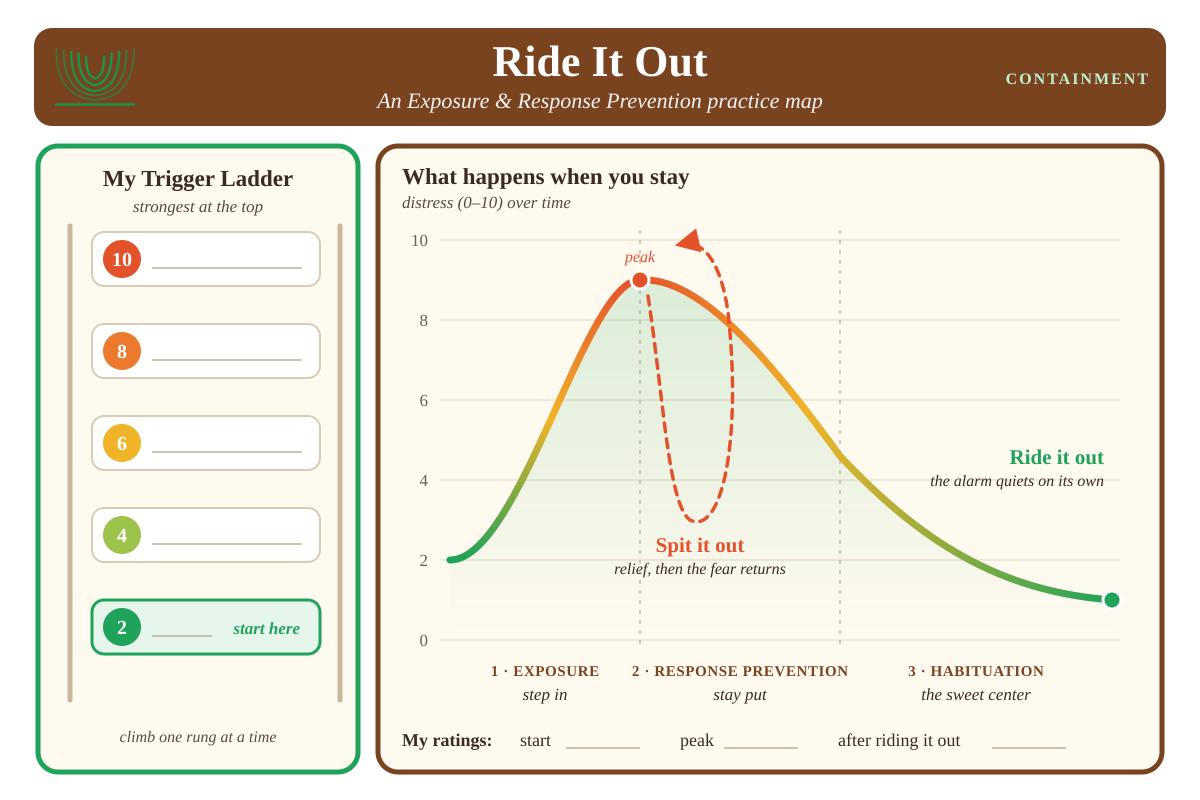
To understand how this rewires the brain, we first map out our landscape by creating a hierarchy of triggers, sorting them from strongest to weakest, and starting our work with the most manageable one.
Here is exactly what happens when we step onto that path.
1. The Exposure: Stepping Into the Sourness
- The Action: You intentionally choose to step directly into the trigger without hiding from it.
- The Neuro-Mechanics: Your amygdala—the brain’s emotional smoke detector—mistakes an uncomfortable thought or situation for actual danger. It sounds a false alarm, immediately flooding your bloodstream with adrenaline.
- The Somatic Experience: Your body registers this instantly. Your muscles brace, your heart races, and you feel that deep, instinctual urge to flee the room or your own skin.
2. Response Prevention: Staying Put
This is where the magic—and the hardest work—happens. Response prevention means refusing to perform the compulsion, the ritual, or the safety behavior.
Usually, giving into a compulsion acts like a temporary release valve. It provides a brief moment of relief, which trick the brain into thinking the ritual “saved” your life. But that relief is a trap; it locks you into a toxic feedback loop that reinforces the fear.
By blocking that response, you completely cut off the loop. You choose to sit with the intense sensation on your tongue, so to speak. You show the amygdala that it can ring its alarm all it wants, but you are staying exactly where you are.
3. Neuroplasticity: Finding the Sweet Center
When you refuse to spit the candy out, something remarkable happens: the malic acid coating eventually dissolves. The nervous system simply cannot maintain a peak panic state indefinitely, and through a process called habituation, the alarm naturally begins to quiet down.
Every time we choose to “ride it out” instead of “spit it out,” we expand our capacity for distress tolerance. We are literally practicing neuroplasticity—rewiring our neural pathways through lived, somatic evidence.
Moving Beyond the Tyranny of Fear
Stepping into this process takes immense courage and persistence. But on the other side of that tolerance is freedom from the tyranny of anxiety.
While you will likely have to repeat this practice as you encounter new life stressors and deeper triggers, you walk away with the ultimate proof: you have the capacity to hold the shock, and you don’t have to live in fear of the sourness anymore.
Here is an experiential somatic grounding exercise tailored specifically for the end of your article. It mirrors the theme of “containment” and gives your readers a tangible, physical way to practice riding out intense sensations right in the moment.
Try It Right Now: A Somatic Tool for Containment
If your nervous system feels spiked or activated just reading about this, take a moment to practice a simple somatic container. This isn’t meant to make the discomfort vanish; it is meant to support your body’s capacity to hold it.
- Find Your Frame: Bring both hands to your body. Place your right hand under your left armpit, right over your heart. Take your left hand and wrap it over your right upper arm or shoulder. You are essentially giving yourself a firm, steady hug.
- Notice the Boundary: Feel the physical pressure of your hands against your frame. Notice where your body begins and where it ends. Take a deep, slow breath into the back of your ribcage, feeling your chest expand against this gentle boundary.
- Let the Sensation Arrive: Scan your body for any “sourness”—a tight chest, a knot in your stomach, or a buzzing in your throat. Instead of trying to push it away or fix it, simply say to yourself: “I am big enough to hold this.”
- Ride It Out: Stay in this shape for 30 to 60 seconds. Let the sensation peak, ripple, and naturally soften within the safe, physical container you have created.
By staying present through the pucker, you teach your brain that you don’t need to flee. You are capable of riding it out.
Reference:
PESI training: 2-Day Anxiety Certification Course: Integrate CBT and Exposure & Response Prevention for Treatment of GAD, Panic Disorder, OCD, Social Anxiety & Phobias (Digital Seminar)